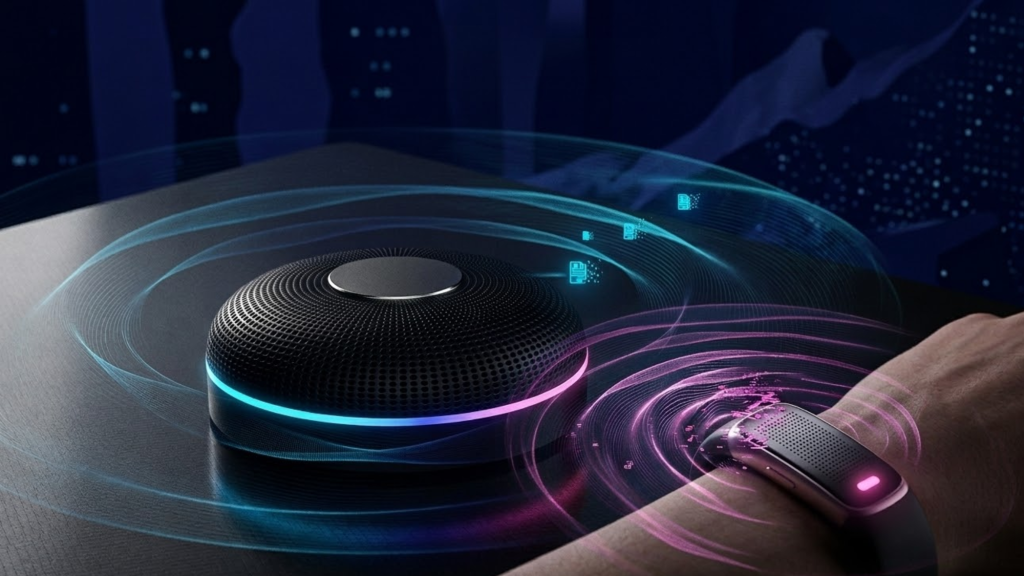
A new gadget called the Spectre I went viral in March 2026. Developed by a Harvard grad, it’s a $1,199 tabletop orb that claims to block nearby devices from recording your voice. Social media split instantly. Half the internet called it cyberpunk resistance tech. The other half said the physics simply don’t work.
Both sides are partially right. Audio jammers are real, the technology behind them is legitimate, and the anxiety driving their popularity is completely justified. But whether a specific audio jammer can actually protect your private conversations from modern AI wearables is a much harder question, and the honest answer is more complicated than either camp wants to admit.
Here’s what you actually need to know about audio jammers, white noise generators, and whether either one can protect your conversations from today’s AI recording devices.
The AI Wearable Problem Is Real
The Spectre I didn’t emerge from nowhere. It’s a product of a specific moment: the rapid spread of always-listening AI wearables designed to passively record ambient audio and feed it to AI models for context and recall.
Devices like Bee AI, Omi, and Friend clip to your clothing and record your conversations throughout your day. NollyTech’s overview of top AI wearables covers how these devices work. Those conversations end up on someone else’s servers. The idea is that an AI with access to everything you say can become genuinely useful. The privacy tradeoff is enormous.
People want a solution. An audio jammer that can block these devices from capturing clear audio is an appealing answer, and the idea of personal protection from always-present surveillance genuinely resonates. The question is whether it actually works.
How an Audio Jammer Works
An audio jammer uses ultrasonic waves, frequencies above the range human ears can detect, to saturate nearby microphones with noise. The microphone diaphragm, which vibrates to convert sound waves into an audio signal, picks up ultrasonic-frequency interference along with the voices in the room. The result is a recording full of distortion, making it hard to extract clean speech.
Think of it like shining a bright light directly at a camera sensor. You can still hear the shutter click, but the resulting image is unusable. The audio protection works the same way: you can hear the conversations, but the recording can’t.
White noise generators work differently. Instead of using ultrasonic waves to interfere with microphone hardware, white-noise generators produce broadband noise that masks speech in the audio signal. If you’ve ever tried to have a sensitive talk near a loud HVAC unit or a running fan, you’ve experienced a low-tech version of this effect. Voice recorders, audio recorders, and audio recording devices share the same vulnerability: they can’t separate speech from sufficiently loud ambient noise. White noise works by making it hard to hear or record meaningful speech amid the surrounding noise; it’s not jamming the recording device itself, it’s drowning out the signal.
Both white noise and ultrasonic audio jammers have legitimate uses. They’re popular tools for protecting private conversations in offices, legal settings, and other settings where sensitive discussions happen regularly. They help protect conversations from hidden microphones, voice recorders, and electronic recording devices that someone might have placed in a room without your knowledge. They’re widely available for personal use, and many businesses use them to protect sensitive talks in conference rooms.
The Ultrasonic Approach: Real But Limited
Ultrasonic jammers work well against certain microphone types, particularly older, larger condenser microphones that are more susceptible to ultrasonic interference. Modern AI wearables are a different problem.
The microphones inside devices like Bee AI use MEMS (micro-electro-mechanical systems) technology. MEMS microphones are smaller, more precise, and, critically, have better signal filtering than traditional microphone designs. They’re specifically engineered to capture clear audio in noisy environments. Their architecture makes them less susceptible to the ultrasonic interference that an audio jammer relies on.
There are three other structural problems:
- Line-of-sight requirements. Ultrasonic waves don’t bend around objects the way lower-frequency sound does. An audio jammer on a tabletop creates a field with directional dead zones. A microphone worn on someone’s lapel, tucked behind a jacket, or on the opposite side of the room may be outside the effective jamming range entirely.
- The cloud processing gap. AI wearable apps don’t process audio locally, they ship audio to cloud servers for transcription and analysis. Even if you successfully degrade the audio quality captured by a wearable, cloud-side noise filtering and AI audio enhancement can partially reconstruct degraded recordings. You’re not just fighting the device, you’re fighting the processing pipeline behind it.
- Countermeasures are easy to deploy. An AI wearable company that knows its users are being targeted by audio jammers can ship a firmware update that filters out ultrasonic frequencies before recording. This is not a hypothetical, it’s the same cat-and-mouse dynamic that played out between radar detectors and law enforcement radar. The defensive technology is always one firmware update behind the offensive one.
White Noise Generators: More Practical, Still Imperfect
White noise generators produce a consistent broadband noise that masks conversation from any capture devices in the surrounding environment. In a room context, they work reasonably well. A white noise generator running at sufficient volume will make it significantly harder for hidden microphones or voice recorders to capture intelligible speech.
The limitation is proximity. White noise generators protect a room from external listening devices, but they don’t help much against an AI wearable that someone is wearing on their body. The device is already inside the noise-protected space, close to the person’s voice, and the protection that white noise offers against hidden microphones across the room doesn’t extend to a mic that’s three inches from someone’s mouth. The device is already inside the noise-protected space, pressed against the person’s body. It can hear clearly even when the room is filled with masking sound. The white noise is part of the recording, but so is every word you say.
For office use, legal meetings, or any situation where you control the physical space, a white noise generator is a practical and effective protection layer. Conversations in a properly masked room are significantly harder to capture and transcribe. For protecting private conversations from wearables on people who are physically present, it’s less useful than it sounds.
Different Types of Audio Jammers
Not all audio jamming devices work the same way. Understanding the different types helps you evaluate what any specific product can actually deliver.
- Ultrasonic audio jammers emit high-frequency sound waves that microphones pick up as noise. They’re discreet, generate no audible noise to people in the room, and are effective against many traditional recording devices. Their weakness is the MEMS microphone architecture and frequency filtering built into modern AI wearables.
- White noise generators produce a broadband sound that masks speech in any audio recording made in the same room. They’re louder and more noticeable than ultrasonic jammers, but they work against a wider range of microphones. A white noise generator running at high volume in a room makes it genuinely hard for any recording device, including hidden microphones, to capture usable speech.
- Signal jammers operate differently. Rather than interfering with audio capture, they block the radio frequencies a device needs to transmit data. A signal jammer that blocks a phone’s ability to reach a network also blocks an AI wearable app from shipping audio to the cloud. The legal status of signal jammers varies significantly. In the United States, signal jammers for personal use are prohibited under FCC regulations. In many countries, the rules differ. Understand the laws in your jurisdiction before using one.
Each approach has a different use case. For protecting conversations in a fixed location from hidden microphones and voice-capture devices, a white-noise generator is often the most reliable protection. You can hear clearly in the room, but any device trying to capture speech at a distance can’t. For targeted personal use against nearby recording devices, an ultrasonic audio jammer is more discreet. For preventing recordings from leaving the device entirely, a signal jammer is the most complete solution, where legal.
What Actually Protects Your Conversations
Audio jammers and white noise generators are useful tools. But the most effective privacy tools aren’t technical jammers, they’re habits and choices.
- Leave recording devices out of sensitive conversations. Phones, smart speakers, and AI wearables are all voice recorders in some form. Preventing eavesdropping starts with controlling what’s in the room. If a conversation is genuinely sensitive, the most reliable protection is ensuring electronic devices, including phones, aren’t present.
- Audit your own devices. Most people have microphone permissions granted to apps they never use. A quick audit of microphone access on your phone removes a lot of eavesdropping risk at zero cost. You don’t need an audio jammer to stop apps from listening , you need to revoke the access you already granted.
- Choose AI wearables deliberately. If you’re evaluating AI wearable products, look for open-source platforms like Omi that allow inspection of how audio data is stored and shared. NollyTech’s piece on how much your AI should know about you is worth reading alongside this one. The protection built into the product design matters as much as any external jammer. Closed platforms give you no visibility into what’s actually happening with your recordings.
- Block cloud access. At the network level, an AI wearable that can’t reach its cloud server can’t process or store recordings. Network-level controls at home or in an office can effectively disable AI wearable functionality without any jamming hardware.
- Know your local laws. Privacy laws vary significantly. Many countries and US states require all-party consent for audio recordings. Knowing your jurisdiction’s rules matters. In some cases, protection against eavesdropping is already a legal right, and unauthorized audio capture is already illegal regardless of the technology involved. An audio jammer is a technical tool; knowing the law is the strategic one.
The Spectre I Question
So, where does all of this leave the Spectre I specifically? Deveillance’s Spectre I is a real product from a real founder who is genuinely trying to solve a real problem. At $1,199 and tabletop form factor, it’s not a mass-market solution. And the fundamental challenge, MEMS microphones, cloud processing, the ease of firmware countermeasures, means it’s fighting an uphill battle against the specific devices most likely to threaten private conversations today.
That doesn’t mean audio jammers are useless. In controlled environments, a private office, a conference room with traditional recording devices present, an audio jammer or white noise generator is a legitimate layer of protection. It raises the cost and effort of unauthorized recording even if it can’t guarantee it.
But against an AI wearable ecosystem designed from the ground up to capture ambient audio in noisy environments and process it in the cloud? The honest answer is: probably not enough on its own.
Privacy in the Age of Ambient AI
The Spectre I went viral because it named something real. The spread of always-listening AI wearables represents a meaningful shift in the baseline expectation of privacy in any room, any conversation, any interaction. We’re still in early days of that transition, and the regulatory framework has not kept up.
Technical countermeasures like audio jammers are part of the picture. So are personal habits, device choices, and, most importantly, pressure on the companies building these devices to make privacy-preserving options the default rather than the exception.
The question isn’t just whether you can block a specific recording device. It’s what kind of ambient AI world you’re willing to accept. That question doesn’t have a $1,199 answer.