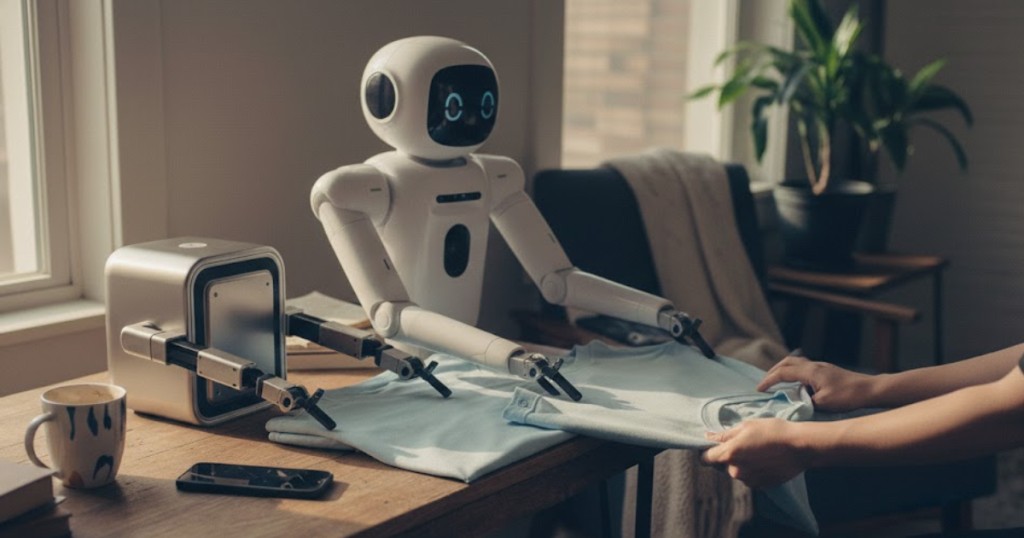
For most of history, folding laundry was one of those household tasks no one could figure out how to automate. Washing machines came over a century ago. Dryers followed. The folding step stayed stubbornly manual. Every few years, a new company would announce a laundry-folding robot at a trade show. Then nothing would ship.
That story changed in February 2026. Weave Robotics launched Isaac 0, and this month it started delivering to homes in the Bay Area. For the first time, you can buy a machine that actually folds your clothes.
This post answers the real questions: Is there a robot that folds laundry? Yes. Is the laundry folding machine real? One is. How much does the laundry-folding robot cost? More than you probably want to spend. Here is an honest breakdown of where this technology stands, which companies are worth watching, and how to assess whether any of this matters for your home.
What Laundry Folding Robots Actually Do
A laundry folding robot is an automated appliance that takes cleaned, dried clothes and folds them into neat stacks without human help. The machine combines cameras, robotic arms, and an AI model trained on real folding jobs. The hardware picks up each garment, processes its shape and orientation, and executes a fold sequence.
T-shirt and Shirt Folding: What Works Well
Isaac 0 reliably handles shirt after shirt. It also folds dress shirts, pants, and towels. It works through a basket of basics and delivers folded stacks that most users find satisfactory. For anyone whose laundry is mostly shirt loads and standard everyday clothing, this covers the bulk of the job.
The catch is how you load it. Users must enter items one by one. You cannot dump a full basket and walk away. The machine processes each garment individually, so the prep work is on you before folding begins.
Large Blankets and Bedsheets: Current Failures
The same AI that folds a t-shirt cleanly fails on large blankets and bedsheets. Socks, inside-out garments, and sports fabrics are also outside Isaac 0’s reliable handling. Garments turned inside out are also beyond it before folding. If your household generates a lot of these items, you will still be doing that work yourself.
Folding laundry at home means dealing with these edge cases weekly. The technology handles the straightforward part well. The rest requires sorting before you start.
The Real Folding Robot Companies Right Now
Folding Robot Vaporware: A Long Story
Most companies that have announced a folding robot never shipped one. FoldiMate showed a prototype at CES in 2017, collected pre-orders, and shut down in 2021 without delivering any machines. Laundroid, a Japanese company, launched a $16,000 product, connected it to a server that uses AI to analyze clothing, and aims to bring the price below $2,000 in the future. The company has since gone quiet. These are the companies that made skepticism about this category completely reasonable.
7X Robotics built a research machine for Joanna Stern, the Wall Street Journal tech columnist. Two robotic arms, cameras, and a custom AI model. The process for a single t-shirt: pick up the garment, drop to flatten it, reflatten it to correct degrees of rotation, then fold. Each shirt takes two to three minutes. Socks and more complex garments remain unsolved. It demonstrated that the technology works. It is not a product.
Which Laundry Folding Robot Actually Ships
Isaac 0 from Weave Robotics is the only laundry-folding robot currently in homes. Priced at $7,999 upfront or $450 per month on subscription, it folds most clothing, towels, and pillowcases in 30 to 90 minutes per load. The company relies on weave specialist teleoperators who can sub in remotely for a few seconds when it encounters something unfamiliar, then hand control back. The model improves week by week based on real correction data.
LG CLOiD debuted at CES 2026 in Las Vegas. It can fold laundry, but it does so slowly and somewhat sloppily, taking about 30 seconds to fold a single dish towel. It is a head unit with two articulated arms on a wheeled base, designed to coordinate household tasks across connected home appliances using LG’s ThinQ ecosystem. Understanding how smart home standards connect devices matters here. CLOiD is betting on a fully integrated home, not a standalone product. No shipping date or consumer price has been announced.
Why Folding Laundry Took Decades to Automate
The puzzle of folding clothes kept engineers working for decades, even as robots mastered surgery, factory floors, and autonomous navigation in real-world conditions. The reason is fabric. A rigid component on an assembly line behaves the same way every time. Clothing does not. Every shirt arrives in a different shape depending on how it was washed, how it landed in the basket, and how many times it has been worn.
Why a T-shirt Is Harder Than Surgery for a Robot
Surgical robotics operates in a controlled environment with predictable materials. The same AI vision breakthroughs that enabled autonomous vehicle navigation milestones also fed directly into garment recognition. A t-shirt in a laundry basket is a deformable object with no fixed shape. The software must determine the shirt’s start and end points, its orientation, and a fold that works regardless of whether it arrived crumpled, twisted, or inside out.
For years, the processing time required to do this kind of AI vision analysis was measured in minutes per garment. The Laundroid robot took 5 to 10 minutes to fold a single T-shirt and could complete a full load in a couple of hours. Incremental advances in AI vision, more precise robotic grippers, and cheaper components eventually brought that time down to something practical. The gravity and physics of handling soft materials still limit what is possible, but the category crossed a threshold in 2026 that it had not crossed before.
Aerospace engineers and robotics researchers spent years trying to address the low center-of-gravity problem that causes garments to slump and shift during handling. The current safety net is the human teleoperator. The longer-term solution is a model that learns quickly enough to need that safety net less and less.
What the Pricing Model Is Actually Telling You
Isaac 0 costs $7,999 upfront or $450 per month. Before you determine whether it is worth it for your household, understand what the model is telling you.
This is not a consumer price. It is an early adopter price. Weave is not selling to people who are hoping to save money on folding laundry. They are selling to users who want first access to a new category of AI-powered home automation. For that audience, the cost is secondary to the experience and the story.
The subscription model signals that Weave sees this as a service, not a one-time product. The AI model gets updated. Tracking how AI products are evolving in 2026 helps put Weave’s model update strategy in context. The weave specialist network stays on call. The company provides ongoing human infrastructure as part of your monthly fee. You are not buying an appliance. You are buying access to a system that includes a machine, an AI, and a backup human being at all times.
That human beings detail matters. Weave is being honest that its autonomous robot is not yet fully autonomous. They built a safety net into the subscription rather than overpromising. That kind of company behavior is worth noting when you are evaluating whether to buy a first-generation product.
Compare this to Laundroid, which is priced at $16,000 and is now largely inactive. The lesson: a high price does not guarantee the company survives.
When a Laundry Folding Robot Is Worth Buying
People often ask what Elon Musk’s cooking robot is about, referring to Tesla Optimus and the broader wave of general-purpose humanoid robots currently being developed. Those machines are designed to handle a wide range of jobs AI will replace in homes and across many domains. They represent a different bet than Isaac 0. Weave built a dedicated folding machine. Tesla is building a general household robot. Both are early. Neither is ready for most homes at mainstream prices.
The T-shirt Test and the Folding Laundry Math
The clearest signal for whether a laundry-folding robot is worth it today is the t-shirt test. If the majority of the clothes you fold each week are t-shirts, dress shirts, and pant,s loads with minimal bedsheets and sports gear, Isaac 0 covers most of your folding work. Users in that situation who also live in the Bay Area and can justify the cost have a genuine case to make.
For everyone else, the math on folding laundry does not work yet. Hours saved per week versus $450 per month or a high upfront cost. Most households will find that number unfavorable until the price drops significantly.
What a Folding Robot Needs Before You Buy
Three things need to happen before a folding robot makes sense for mainstream purchase. The price needs to drop below roughly $2,000. The reliability must match that of a standard home appliance. The capability must cover most of the load without requiring users to pre-sort and feed items individually.
Isaac 0 is 0-for-3 today. That does not mean the technology is not real. It means it is not yet ready for most people. Watch the video updates and product announcements. Look for announcements of expanded shipping availability beyond the Bay Area, a lower subscription price, or the ability to process a full basket without individual item loading.
Is a Laundry Folding Robot Worth It Right Now?
For most people, no. The price is too high, and the capability covers too little of a real laundry load. People have to pre-sort, feed items one by one, and accept that large blankets and bedsheets remain manual tasks.
If you are in the Bay Area, willing to pay early-adopter prices, and your weekly pile is mostly t-shirts and shirtloads, Isaac 0 is a real product that does real work. The machine folds. The AI learns. The weave specialist is there when it does not.
As a category, it is no longer fictional. One company shipped a product in February 2026 that is installed in actual homes. That is the first time in the history of this technology that a sentence has been true. The future version of this, the one that works for everyone at a price that makes sense, is now a question of time rather than a question of whether it is possible.
Learn more and follow Weave’s progress at weaverobotics.com.