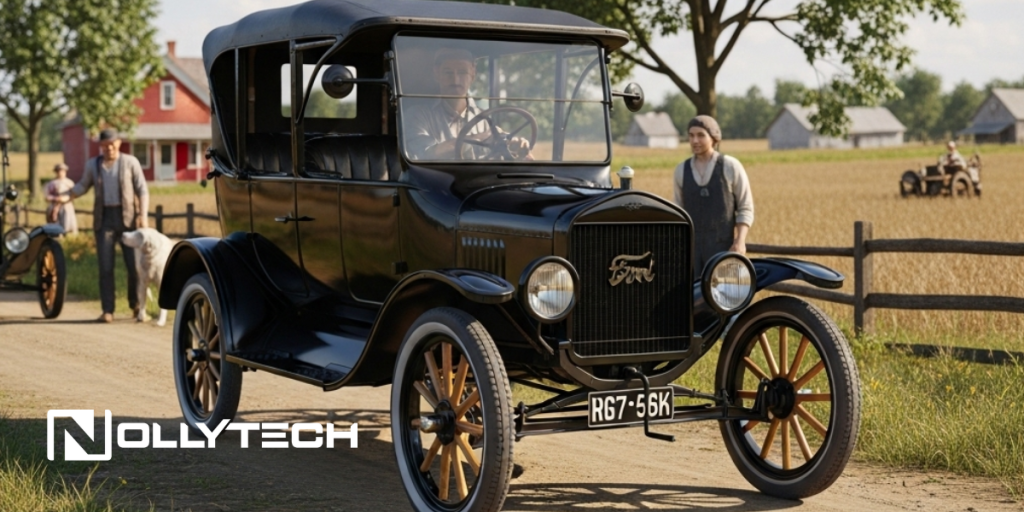
What was Ford’s revolutionary idea? Henry Ford’s revolutionary idea was simple yet transformative: create a motor car for the great multitude by combining innovative engineering with mass production techniques that would make automobiles affordable for average workers earning a good salary.
Ford Motor Company’s technological evolution from 1896 to 1920 represents Ford’s technological revolution that fundamentally changed the auto industry. Beginning with Henry Ford’s experimental Quadricycle and culminating in the revolutionary Model T, this era transformed the automobile from an invention bought by the wealthy into affordable mass transportation.
What did Ford introduce in 1913 and why did it revolutionize auto manufacturing? Ford introduced the moving assembly line in 1913 at Highland Park, which revolutionized auto manufacturing by reducing Model T assembly time from twelve hours to just one hour and thirty minutes, making cars affordable for the masses.
This comprehensive analysis examines how Ford Motor Company’s engineering innovations, manufacturing breakthroughs, and technological advancements enabled this transformation. You’ll discover how Henry Ford’s integrated approach combined innovative materials, revolutionary engine design, and the transformative moving assembly line to create solutions that continue influencing modern production engineering.
Why Ford’s innovations still matter to you today
What effect did Ford’s innovations have on the economy? Ford’s innovations transformed the American economy by creating high wages for workers, enabling mass production that reduced costs, and establishing the foundation for modern consumer culture where workers could afford the products they manufactured.
Ford Motor Company’s approach didn’t rely on a single breakthrough. Instead, Henry Ford created an integrated system of engineering solutions that you can still observe in modern manufacturing:
Key innovations that changed everything:
- Innovative materials: Vanadium steel usage that improved strength while reducing weight
- Revolutionary engine design: Monobloc cylinder casting and thermosyphon cooling
- Manufacturing transformation: The moving assembly line that changed the auto industry forever
These innovations collectively reduced costs while improving quality, durability, and reliability. This made automobile ownership practical for average Americans and established principles that continue influencing your daily life through modern production engineering.
The collaborative engineering approach that changed everything
What did Ford do in the Industrial Revolution? Ford revolutionized the Industrial Revolution by pioneering the moving assembly line, implementing mass production techniques, and creating standardized parts that transformed not just the automotive industry but manufacturing industries worldwide.
Ford Motor Company’s technological evolution was driven by Henry Ford’s collaborative engineering approach. He brought together young, talented engineers to solve complex problems through systematic experimentation.
Their work fundamentally changed not just automotive design but manufacturing techniques across all industries. When you see an assembly line today, you’re witnessing Ford’s legacy of innovation.
Henry Ford’s experimental foundation (1896-1903)
Before Ford Motor Company revolutionized manufacturing, Henry Ford spent years developing his engineering philosophy through hands-on experimentation. This formative period established the foundation for Ford Motor Company’s later revolutionary approach to automotive design and manufacturing techniques.
Developing an engineering philosophy through experimentation
Henry Ford’s approach to innovation was deeply rooted in practical experimentation rather than formal engineering education. Despite having only a sixth-grade education, Henry Ford developed a natural mechanical ability and a distinctive problem-solving approach.
Early collaborative signs: In elementary school, Henry Ford enlisted friends to assist with projects like damming streams to power waterwheels or building rudimentary boilers and steam turbines. Ford directed the work while others executed his vision.
This collaborative approach became a hallmark of Ford Motor Company’s engineering methodology. Rather than working as a solitary inventor, Henry Ford excelled at identifying specific challenges and developing practical solutions:
- Identifying problems through careful observation
- Conceptualizing solutions based on mechanical principles
- Assembling teams of talented individuals to implement ideas
The Henry Ford Museum notes Henry Ford’s most valuable trait: “his ability to identify and attract outstanding talent. He hired a core of young, highly competent people who would stay with him for years and make Ford Motor Company into one of the world’s great industrial enterprises.”
Learning through systematic experimentation
Henry Ford’s early fascination with machines began with taking apart toys and learning about steam engines from their operators. This hands-on approach to understanding mechanical systems influenced his later automotive design innovations.
Key design priorities that emerged:
- Simplicity over complexity
- Serviceability for average users
- Durability under harsh conditions
Pre-incorporation vehicles and early lessons
Before establishing Ford Motor Company in 1903, Henry Ford was involved with several earlier automotive ventures that provided valuable learning experiences. When Ford Motor Company was created, it was the latest in a string of companies Henry Ford had been associated with in attempting to build and sell moving vehicles.
Ford’s strategic approach: Since Henry Ford personally knew many industrialists in Detroit, he planned to build automobiles they could use in their businesses. However, building such complex machines in high numbers proved much more difficult than Henry Ford imagined.
The Quadricycle: Ford’s first breakthrough
Henry Ford’s first significant experimental vehicle was the Quadricycle, completed in 1896. This simple four-wheeled vehicle represented a major milestone in automotive history and the beginning of Ford’s journey toward true innovation.
Quadricycle specifications:
- Engine: Two-cylinder, four-horsepower gasoline engine
- Frame: Angle iron construction for durability
- Wheels: Bicycle wheels for simplicity and availability
- Weight: 500 pounds
- Top speed: 20 mph in second gear
- Transmission: Two forward speeds, no reverse
- Fuel capacity: 3 gallons
While primitive by later standards, the Quadricycle represented an important first step in Henry Ford’s automotive career. It provided valuable lessons in engine design, power transmission, and vehicle construction that would inform his later innovations.
On June 4, 1896, Henry Ford faced an unexpected challenge: the completed vehicle was too wide for his workshop door. Using an axe, he demolished part of the brick wall to roll the Quadricycle onto Detroit’s streets.
Critical technical challenges identified
The early experimental period revealed several technical challenges that Ford Motor Company would need to overcome to create successful production vehicles.
Manufacturing consistency challenges:
Early automotive production relied on skilled craftsmen creating components that required extensive hand-finishing. This approach was time-consuming, expensive, and resulted in vehicles that were difficult to maintain because parts weren’t truly interchangeable.
Engine development obstacles:
Developing engines powerful enough for practical transportation yet simple enough for reliable operation proved challenging. Early automotive engines were often adapted from stationary industrial engines and weren’t optimized for mobile applications.
Materials limitations:
Traditional materials used in carriage-making and early automobiles lacked the strength-to-weight ratio necessary for efficient, durable vehicles.
Manufacturing efficiency problems:
Early automobile production methods were essentially artisanal, with vehicles built individually by teams of skilled workers. At the time, virtually all cars were high-ticket items made by skilled craftsmen one at a time, often designed for racing rather than practical transportation.
Early Ford Motor Company production models evolution (1903-1908)
The period from Ford Motor Company’s incorporation in 1903 through 1908 saw rapid technological evolution across multiple production models. During these formative years, you can observe Henry Ford and his engineering team experimenting with different approaches to engine design, chassis construction, and manufacturing techniques.
Ford Motor Company’s strategic formation
Ford Motor Company was incorporated on June 16, 1903, with 12 investors and 1,000 shares of stock. Unlike his previous automotive ventures, Henry Ford wasn’t the primary financial backer. Instead, Ford invested his knowledge, experience, reputation, and hard work but no cash.
This arrangement gave Henry Ford the freedom to focus on engineering and production while others handled the financial aspects. However, tension existed between Ford and some investors regarding Ford’s company direction.
The philosophical divide: Some favored building grand cars for the rich, each with a large profit margin. Henry Ford advocated building simpler, less expensive cars that would yield smaller profit per car but might expand the auto market.
This philosophical difference influenced Ford Motor Company’s technical approach, pushing Henry Ford toward simpler, more robust engineering solutions that could be manufactured efficiently and maintained easily by owners.
Model A through Model S: Rapid technical evolution
Each successive model incorporated lessons learned from previous vehicles, gradually refining Henry Ford’s vision of an affordable, reliable automobile for the masses.
The Model N breakthrough: Introduced in 1906, the Model N was particularly significant as a precursor to the Model T. Priced at $500, the Model N became the top-selling car in America by 1907.
Joseph Galamb, who would later play a crucial role in designing the Model T, began his career at Ford Motor Company at the Ford Piquette plant designing parts for the Model N. Henry Ford soon put him to work on experimental work in a private drafting room where Galamb worked on the Model T design.
Building the revolutionary engineering team
A critical aspect of Ford Motor Company’s great success during this period was Henry Ford’s assembly of a remarkably talented and youthful engineering team. Ford’s engineering team was remarkably young, with key contributors bringing diverse technical backgrounds and innovative thinking:
- C. Harold Wills: 21 years old
- Joseph Galamb: 24 years old
- Charles Sorensen: 24 years old
Joseph Galamb’s contribution: A Hungarian immigrant who came to the U.S. from Hungary in 1903, started work at Ford Motor Company in 1905, and retired from Ford Motor in 1944. He would become particularly influential in the development of the Model T.
Edward “Spider” Huff: At age 28, he was a self-taught electrical engineer and inventor of the breakthrough flywheel magneto. He’s also credited with the idea of encasing spark plugs in porcelain.
This collaborative engineering environment fostered innovation and allowed Henry Ford to draw on diverse talents and perspectives. The team’s youth and relative inexperience in traditional automotive design may have been an advantage, freeing them from preconceived notions about how automobiles “should” be designed.
Ford’s approach to innovation through collaborative engineering demonstrated how bringing together diverse talents could solve complex technical challenges more effectively than individual inventors working alone.
The revolutionary Model T breakthrough (1908-1915)
The Model T represented a revolutionary approach to automotive design that you can still observe in modern manufacturing principles. Its success stemmed not from a single breakthrough but from an integrated system of technological innovations working together.
The secret experimental room where revolution began
The development of the Model T began in earnest in early 1907, when Henry Ford ordered the construction of a room in the northeast corner of the Piquette Avenue plant’s third floor. Behind its padlocked door, he installed Joe Galamb and his drafting table.
Creating the perfect environment: This 870-square-foot experimental room was deliberately isolated and secured. Ford demanded “a good lock” and limited access to just seven other people besides himself.
The secrecy surrounding the Model T’s development reflected its strategic importance to Ford’s vision. Within this space, Ford and his small team worked to create “a completely new job” rather than simply evolving previous models.
Equipment and methodology: The experimental room was equipped with period-appropriate tools including a drafting table, chalkboard, camera, workbench, and belt-driven machine tools powered by a 250-volt DC motor.
Ford’s approach to the design process was highly collaborative but also hands-on. When Galamb completed the drawing of the revolutionary transmission design, Mr. Ford instructed Galamb to have a small brass model made. The gears and drums were all made from brass, and the design could be tested by holding one of the drums between their fingers.
Comprehensive testing for real-world conditions
Before the beginning of serial production of the Model T, Ford, together with his collaborators, worked three years on its design, experimentation, and research. Experimental cars were driven in all conditions varying from snow and slush-covered roads to country roads.
This extensive testing ensured that the final design would be capable of handling the challenging road conditions typical of early 20th-century America.
Engine design innovations that changed everything
The Model T’s engine represented several significant innovations in automotive powerplant design that you can trace to modern engines today.
Core specifications:
- 177 cubic inch (2.9 L) inline four-cylinder engine
- 20 horsepower output
- Top speed of 45 mph (72 km/h)
- Excellent balance of power, efficiency, and reliability
The revolutionary monobloc design
One of the most significant innovations was the engine’s monobloc design, with all four cylinders cast into one engine block. Such a monobloc design was uncommon when T production started in 1908.
Why this mattered: In 1909, only 7% of cars had one-piece engine blocks, making the Model T’s design distinctly advanced for its time. This design choice lent itself to mass production, showing Ford company’s prescient focus on design for manufacturability.
Serviceability breakthrough: The engine also featured a removable cylinder head, which made maintenance and repair infinitely easier. Before the Model T, car engines typically had their heads and blocks cast as a single lump of iron, with separate cylinders bolted to the crankcase, making them heavy and time-consuming to produce or repair.
Multi-fuel capability through smart engineering
The Model T engine’s adaptability to different fuels became one of its most discussed features. While the Model T engine was built as a gasoline engine and wasn’t specifically engineered for multifuel ability, its simple, robust design allowed a modified engine to successfully run on various combustible fuels including benzene, ethanol, or kerosene.
The practical advantage: This fuel flexibility was partly a consequence of the engine’s low compression ratio of 3.98:1, which was intentionally designed to be forgiving of low-quality fuel and minimize starting effort.
At a time when oil companies sometimes diluted rare gasoline with kerosene to keep up with surging demand, that low compression ratio was a much-needed tool to combat varying quality of gas.
Thermosyphon cooling: Eliminating complexity
One of the Model T’s most distinctive technical features was its thermosyphon cooling system, which eliminated the need for a water pump. While the first 2,500 Model T’s came with water pumps, the subsequent 15,004,533 Model T Fords came from the factory with no water pump.
How thermosyphon works: The system relied on natural convection principles. Heat rises as water (or coolant) is heated in the engine’s water passages, it becomes less dense (lighter) and rises up through the hose into the radiator’s top tank. As water in the radiator is cooled, it becomes more dense (heavier) and sinks.
This natural circulation eliminated the need for a mechanical pump, reducing complexity and potential points of failure. The effectiveness of this system depended heavily on proper maintenance and operating conditions.
Planetary transmission: Revolutionary ease of use
The Model T’s transmission represented another revolutionary design choice that prioritized ease of use over conventional automotive practice. The Model T Ford gearbox used a planetary transmission that was completely unlike epicyclic units such as those under the Wilson patents.
Unique design features:
- Combined transmission and flywheel, saving weight
- Featured three sets of triple planet gears arranged at 120 degrees
- Allowed for low gear, high gear, and reverse
- Used an intricate clutch mechanism with 25 multiple clutch discs
Focus on accessibility: The planetary transmission design was specifically chosen to make the car accessible to drivers with no previous automotive experience. Its target market was rural Americans who had never driven a motor car and could therefore learn to drive it with ease.
Remarkably, the transmission is perhaps the only part which went unchanged throughout the 19 years of production, demonstrating the fundamental soundness of the original design.
Vanadium steel: The strength revolution
One of the Model T’s most significant material innovations was its extensive use of vanadium steel, which dramatically improved the vehicle’s strength-to-weight ratio.
The discovery story: In 1905, Henry Ford discovered a French-made steel-vanadium alloy. Impressed by its low weight and high strength, he used V-steel in the chassis of the Model T, reducing the car’s overall weight to about half that of contemporary automobiles.
Manufacturing challenges: Few furnaces in the US could even reach the temperature needed to manufacture it. The difficulty in producing it was worth it because vanadium steel was more than twice as strong as regular steel while actually being lighter.
To overcome this obstacle, in 1907, Henry began construction of a heat treatment plant to produce vanadium steel.
Performance impact: Ford believed that Americans wanted a light car, and the finished Model T touring car fit the bill, weighing only 1,200 pounds. No other popular four-passenger car came close:
- Buick Model 10 Tourabout ($1,050): 1,570 pounds
- Overland Model 32 Toy Tonneau ($1,500): 1,750 pounds
Manufacturing innovations that changed the world (1910-1915)
Ford Motor Company’s manufacturing innovations during the 1910-1915 period represent one of the most significant Industrial Revolution transformations in history. These innovations dramatically reduced costs while improving quality and consistency, establishing manufacturing techniques that continue influencing modern production engineering.
Highland Park Plant: The factory that changed everything
The Highland Park plant, which opened in 1910, was nothing less than the most influential factory of the 20th century. Within its walls, Henry Ford and his associates developed the moving assembly line, introduced high wages for workers, and produced millions of reliable and affordable Model T automobiles.
Key facility features:
- Location: Highland Park, Michigan
- Size: 60-acre plant on 130-acre tract
- Architect: Albert Kahn (nicknamed the “Crystal Palace”)
- Construction: Steel reinforced concrete for fire safety
- Innovation: Large, open manufacturing spaces ideal for assembly lines
Comprehensive integration approach:
The new Ford Motor plant would be able to manufacture everything from bodies to engines, and every part of the Model T chassis when fully operational. This represented a significant departure from previous automotive manufacturing practices where components were sourced from multiple suppliers.
Ford Motor Company embraced the concept of ‘vertical integration’ completely. The philosophy was to control every process involved in manufacturing, from raw materials to finished product, capturing every bit of profit in every step of the product’s life cycle.
Revolutionary logistics and power systems
The Highland Park plant pioneered advanced manufacturing logistics that you can still observe in modern factories today:
Advanced manufacturing systems:
- Specialized machine tools: Including milling machines that could process 15 engine block castings simultaneously
- Overhead monorail conveyor system: More than a mile and a half of track to move parts throughout the factory
- On-site power generation: Coal-fired steam engines and DC generators for complete self-sufficiency
By 1924, the Highland Park Plant was producing an average of 5,400 cars per day, a production volume that would have been unimaginable using traditional manufacturing techniques.
The moving assembly line: Transforming industrial production
The moving assembly line, Ford introduced at Highland Park in 1913, represents one of the most significant manufacturing innovations in industrial history.
Development inspiration:
At Ford Motor Company, the assembly line was introduced by William ‘Pa’ Klann upon his return from visiting Swift & Company’s slaughterhouse in Chicago and viewing what was referred to as the ‘disassembly line’.
The evolution of assembly line manufacturing from cottage industries to modern production transformed not just the automotive industry but manufacturing industries across all sectors.
Evolutionary development process:
Ford Motor Company’s production system evolved through constant experimentation, not a predetermined vision, with young mechanics continuously testing and refining processes.
Core assembly line principles:
The revolutionary system was based on two critical concepts:
- Interchangeable parts: Components manufactured to precise specifications
- Subdivision of labor: Each worker performed a specific, limited task
Dramatic efficiency transformation:
The impact on production efficiency was revolutionary. By 1914, a Model T could be fully assembled in just over one hour and a half man-hours, compared to twelve and a half hours using previous stationary methods.
This increased efficiency allowed Ford Motor Company to continuously reduce low prices while maintaining or increasing profit margins, making the Model T increasingly affordable to average Americans.
Industry-wide transformation effects
The assembly line techniques pioneered at Highland Park spread throughout the auto industry and into other manufacturing industries as well. The high wages and low-skill jobs pioneered at Highland Park also spread throughout the manufacturing sector.
However, the assembly line created significant challenges. Ford Motor Company workers disliked the new assembly line methods so much that by late 1913, labor turnover reached 380 percent.
The transformation from manual craftsmanship to automated production represents a fundamental shift that parallels how modern automation examples continue reshaping manufacturing across industries today, from automotive assembly to electronics production.
Achieving true interchangeable parts
A critical foundation for Ford Motor Company’s assembly line was achieving true interchangeable parts. These were components manufactured with such precision that they could be assembled without hand-fitting or adjustment.
Technical breakthrough details:
Ford Motor Company first achieved part interchangeability in 1908. Unlike previous efforts, these parts were produced by machines accurate enough that they didn’t require hand-finishing afterwards.
This breakthrough was made possible by the development of high-speed tool steel in 1900, which was crucial in enabling precise machine-made parts without hand-finishing.
Manufacturing revolution impact:
This eliminated the craft-production work done by skilled fitters and opened the door for a long stream of optimizations and advancements to the production process.
The Five Dollar Day revolution
The introduction of high wages through the Five Dollar Day in January 1914 represented a revolutionary approach to workforce management that complemented Ford Motor Company’s manufacturing innovations.
Dramatic wage transformation:
Henry Ford implemented several groundbreaking changes simultaneously:
- Wage increase: From $2.34 to $5.00 per day (equivalent to $73 to $157 in today’s dollars)
- Hour reduction: From nine-hour to eight-hour work days
- Shift expansion: Created a third shift for 24-hour operation
Strategic multiple purposes:
The Five Dollar Day served several critical functions:
- Addressed severe turnover problems from assembly line implementation
- Created a workforce that could afford to purchase the products they manufactured
- Helped establish a new consumer economy with increased disposable income
With that one move, Henry Ford stabilized his workforce and gave workers the ability to buy the very cars they made.
Broader economic implications:
The Five Dollar Day anticipated the consumer economy that would develop in the United States in the following decades, demonstrating how manufacturing innovation could drive social and economic transformation.
Engine development mastery (1905-1915)
The decade from 1905 to 1915 represented a critical period in Ford’s engine development. During this time, Ford established fundamental design principles that would influence automotive engineering for decades.
Pre-Model T engine evolution and learning
Ford’s early production vehicles featured various engine configurations as the company experimented with different approaches to power generation. The Model A of 1903 used a horizontally opposed two-cylinder engine producing 8 horsepower.
The Model N breakthrough: A significant step in this evolution was the four-cylinder engine used in the Model N, introduced in 1906. This engine established the basic architecture that would later evolve into the Model T powerplant.
The Model N’s success validated Ford’s approach to engine design and provided valuable real-world experience that informed subsequent development.
Model T engine technical mastery
The Model T engine represented the culmination of Ford’s early engine development efforts, incorporating numerous innovations that balanced performance, reliability, and manufacturability.
Core specifications:
- Displacement: 177 cubic inches (2.9 L) inline four-cylinder design
- Power output: 20 horsepower at 1,600 RPM
- Torque: 83 pound-feet at 900 RPM
- Top speed: 42-45 mph
- Compression ratio: 3.98:1 for fuel flexibility
- Configuration: Side-valve with reverse-flow cylinder head
Revolutionary design choices:
The monobloc casting with all four cylinders cast into one engine block was an uncommon practice when T production started in 1908. Combined with the removable cylinder head, this design made the engine both easier to manufacture and easier to service.
This innovation was particularly significant because in 1909, only 7% of cars had one-piece engine blocks, making the Model T’s design distinctly advanced for its time.
Cooling system innovation
The Model T’s cooling system evolution provides an interesting case study in Ford’s engineering philosophy. The first 2,500 Model Ts were equipped with water pumps, but Ford quickly transitioned to a thermosyphon cooling system.
Why eliminate the water pump: This change eliminated a mechanical component in favor of a system that relied on natural physical principles. Cost reduction was certainly a factor, but reliability and simplicity were also important considerations.
Ford intended the Model T to be as simplistic as possible so the average farmer or knowledgeable person could fix or repair most common problems with minimal hand tools just about anywhere. The fewer parts, the less to break and the less to repair.
Fuel system and practical adaptability
The Model T engine was built as a gasoline engine. While not engineered specifically for multifuel ability, its simple, robust design allowed a modified engine to successfully run on various combustible fuels including benzene, ethanol, or kerosene.
Practical fuel flexibility: Thanks to its incredibly low compression ratio, virtually any liquid hydrocarbon would likely keep the Model T moving. At a time when oil companies sometimes diluted rare gasoline with kerosene to keep up with surging demand, that low compression ratio was a much-needed tool to combat varying quality of gas.
Ignition system innovations
The Model T’s ignition system represented another area where Ford diverged from conventional automotive practice in pursuit of simplicity and reliability.
Flywheel magneto breakthrough: The most significant innovation was the flywheel magneto, which integrated electrical generation directly into the engine’s flywheel. This system was developed by Edward “Spider” Huff, a self-taught electrical engineer and inventor of the breakthrough flywheel magneto.
Elegant simplicity: Permanent magnets were attached to the flywheel, which rotated past stationary coils to generate electricity for the ignition system. This eliminated the need for a separate generator or battery for ignition, reducing complexity and potential points of failure.
The flywheel magneto was the first Model T component to be assembled on an assembly line, setting a precedent for Ford’s manufacturing innovations.
Comparing Ford’s approach to competitors
Ford’s technological approach differed significantly from his competitors, reflecting fundamental differences in business philosophy and target markets. Understanding these differences helps you appreciate why Ford’s innovations were so revolutionary.
Ford versus Cadillac: Two engineering philosophies
The contrast between Ford’s engineering philosophy and that of Cadillac (led by Henry Leland) provides an illuminating case study in different approaches to automotive technology.
Cadillac’s precision approach: Cadillac, under Leland’s leadership, prioritized precision manufacturing and technical sophistication. Leland was known and respected for his fanatical devotion to precision manufacturing and focused on producing high-quality, premium automobiles.
Cadillac’s transmissions were so precisely manufactured that their components were actually interchangeable from car to car, a novel idea at that time.
Ford’s simplification philosophy: Ford prioritized simplicity, durability, and manufacturability over technical sophistication. The Model T retained the hand crank starter throughout its production run, despite the availability of electric starter technology.
This decision reflected Ford’s focus on keeping the vehicle as simple and affordable as possible, even at the cost of some convenience features.
Different target markets, different solutions
These contrasting approaches reflected their different target markets:
- Cadillac: Aimed to produce “the standard of the world” for wealthy customers who valued refinement
- Ford: Sought to create “a motor car for the great multitude” that would be affordable and practical
Oldsmobile Curved Dash comparison
The Oldsmobile Curved Dash, introduced in 1901, is often considered the first mass-produced automobile in America. A comparison reveals important differences in engineering approach:
Power and performance: The Curved Dash was powered by a single-cylinder engine producing 4-5 horsepower, significantly less than the Model T’s four-cylinder, 20-horsepower powerplant.
Production innovation: Both Oldsmobile and Ford pioneered aspects of mass production, but Ford’s approach was ultimately more comprehensive and revolutionary.
The Curved Dash’s success demonstrated market demand for affordable automobiles, but its limited performance restricted practical utility. The Model T represented a more complete solution to creating a truly practical automobile for the masses.
Industry-wide impact and standardization
Ford’s technological innovations forced other manufacturers to reconsider their business strategies and technical approaches. By 1918, half of all cars in America were Model T’s, and this trend would continue well into the 1920s.
Competitive response: By 1930, 250 companies without assembly lines had disappeared, demonstrating the technology’s transformative impact.
Ford’s influence extended beyond specific technologies to include broader engineering principles, establishing a distinctly American approach to automotive engineering that differed from European practices.
Socioeconomic transformation through technology
Ford’s technological innovations transformed not just the automotive industry but American society as a whole. By making automobile ownership accessible to average Americans, Ford’s engineering and manufacturing breakthroughs enabled unprecedented mobility that fundamentally changed how people lived and worked.
Democratizing automobile ownership
Ford’s technological innovations dramatically reduced the cost of automobile ownership, making it accessible to a much broader segment of the American population.
Price reduction transformation:
The impact of Ford’s manufacturing innovations on Model T pricing was revolutionary:
- 1908: Model T price around $825
- 1912: Decreased to around $575
- 1917: Reduced to $350 (equivalent to $8,590 in 2024)
- 1921: As little as $415
By 1921, half the cars in America were Model Ts. Through these efforts, Ford turned the automobile from an invention bought by the rich into a true innovation available to a wide audience.
Social perception transformation:
By the 1920s, largely as a result of the Model T’s success, the term ‘pleasure car’ was fading away, replaced by ‘passenger car’. This linguistic shift reflected a fundamental change in how automobiles were perceived from luxury items to essential transportation.
Rural impact and agricultural transformation
The Model T had a particularly significant impact on rural America, where its versatility and durability made it an invaluable tool for farmers and small businesses.
Agricultural applications and modifications:
Beyond personal transportation, the Model T’s design allowed for extensive modification for agricultural and industrial applications.
Common Model T agricultural adaptations:
- Portable sawmills for lumber processing
- Tractor-trailer rigs for hauling
- Grain threshers for harvest operations
- Mobile generators for electrical power
- Water pumps for irrigation systems
As soon as the T’s sales took off, mail-order companies sprang up to help owners modify their Fords for endless uses. With a few tools and a little time, the T could be transformed into campers, portable sawmills, tractor-trailer rigs, grain threshers, and sporty racers, to name just a few.
Rural electrification contribution:
Modified Model Ts could serve as portable generators, providing power for lighting, small appliances, and farm equipment in areas without access to electrical grids. This capability helped bridge the technological gap between urban and rural areas.
Economic transformation through manufacturing
Ford’s manufacturing innovations had economic impacts extending far beyond the automotive industry. The moving assembly line and other production techniques dramatically increased worker productivity, enabling higher wages while reducing product costs.
Creating the consumer economy:
The Five Dollar Day exemplifies this economic transformation perfectly:
When Ford’s workforce objected to the relentless, repetitive work that the assembly line entailed, Ford responded with perhaps his boldest idea ever: he doubled wages to $5 per day.
With that one move, Ford stabilized his workforce and gave workers the ability to buy the very cars they made.
Industry-wide adoption and impact:
The assembly line techniques pioneered at Highland Park spread throughout the auto industry and into other manufacturing industries as well. The high-wage, low-skill jobs pioneered at Highland Park also spread throughout the manufacturing sector.
Ford’s approach to empowering workers through better wages and working conditions demonstrates how information technology continues shaping modern workplaces, creating new opportunities for economic growth and workforce development across industries.
Economic multiplier effects:
Ford’s approach created a virtuous economic cycle:
- Higher wages increased worker purchasing power
- Mass production reduced product costs
- Increased consumption expanded markets
- Economic growth created more opportunities
This model anticipated the consumer economy that would dominate American economic development in the following decades.
Ford’s enduring legacy in modern engineering
Ford’s technological innovations established engineering principles and manufacturing techniques that continue influencing modern automotive design and industrial production today. Understanding these connections helps you appreciate how fundamental engineering concepts transcend specific technologies.
Enduring engineering principles you see today
Many engineering principles established by Ford and his team remain relevant in modern automotive design and manufacturing applications.
Core principles that persist:
- Simplicity and reliability: Ford’s approach to engine design prioritized reliability and serviceability over maximum performance or technical sophistication
- Design for manufacturability: Ford’s integration of product and process design anticipated modern concurrent engineering approaches
- Advanced materials application: Ford’s use of vanadium steel to improve performance while reducing weight remains central in automotive engineering
- Systematic quality control: Ford’s precision manufacturing methods evolved into modern statistical process control
Modern automotive applications:
Today’s engines still follow Ford’s philosophy of designing for reliability over complexity. Modern vehicles use various advanced materials like high-strength steels, aluminum alloys, and composite materials to achieve goals similar to Ford’s vanadium steel implementation.
Limitations and lessons learned
Despite its revolutionary impact, Ford’s technological approach had significant limitations that became increasingly apparent in the later years of the Model T’s production run.
Key limitations identified:
Resistance to change: Henry Ford was ultimately slow to innovate and adapt, which led to declining market share in the 1930s despite earlier revolutionary achievements.
Manufacturing inflexibility: The highly optimized production process developed for the Model T made it difficult for Ford to quickly adapt to new product designs, requiring extensive retooling.
Market evolution challenges: Ford’s focus on a single product prevented adaptation to changing consumer preferences for features like electric starters, enclosed cabins, and style variations.
Ford’s challenges with adapting to technological change mirror contemporary discussions about how technology impacts education, where institutions must balance proven methods with emerging innovations to remain effective.
Important lessons for modern manufacturing:
These limitations provide crucial insights about balancing efficiency with adaptability:
- Standardization vs. adaptation: Need to balance consistency with flexibility
- Efficiency vs. innovation: Highly optimized systems can become barriers to change
- Cost reduction vs. improvement: Focus solely on cost can limit competitive response
Modern applications of Ford’s innovations
Many of Ford’s technological innovations have evolved into standard practices that you encounter in contemporary automotive engineering and manufacturing.
Assembly line evolution:
The moving assembly line has been refined with automation, robotics, and computer control, but its fundamental principle of bringing work to the worker remains unchanged in factories worldwide.
Modern assembly line trends and smart factory innovations continue building on Ford’s foundational concepts, incorporating IoT devices, automation, and data analytics to create even more efficient production systems.
Interchangeable parts development:
This concept has evolved into modern standardization practices, extending beyond physical components to include software modules and digital systems in today’s connected vehicles.
Integrated development processes:
Ford’s approach anticipated modern concurrent engineering practices, now enhanced with digital tools like computer-aided design and manufacturing simulation software.
Supply chain strategy applications:
Ford’s vertical integration concept has evolved into modern supply chain management practices, with companies strategically balancing in-house production with outsourcing based on core competencies.
Quality and precision manufacturing:
Ford’s emphasis on precision manufacturing evolved into modern quality management systems, statistical process control, and lean manufacturing principles that you see in industries ranging from electronics to aerospace.
Influence on contemporary innovation
Ford’s vision of democratizing technology by making it affordable and accessible to average consumers continues influencing modern product development across multiple industries.
Examples in modern technology:
- Personal computers evolved from expensive business tools to household necessities
- Smartphones followed a similar trajectory from luxury items to essential devices
- Electric vehicles are currently transitioning from premium products to mass-market transportation
Ford’s democratization principle mirrors how technology continues creating positive societal changes today, making advanced capabilities accessible to broader populations and driving economic development worldwide.
Fundamental approach applications:
The Ford methodology of combining product innovation with process innovation continues driving technological advancement in sectors including renewable energy, consumer electronics, and medical devices.
Conclusion: Ford’s revolutionary impact on your world
Ford’s automotive technological evolution from 1896 to 1920 represents one of the most significant periods of innovation in industrial history. Through systematic experimentation, collaborative engineering, and revolutionary manufacturing processes, Ford transformed the automobile from an artisanal curiosity into affordable mass transportation that fundamentally changed society.
The integrated innovation system that changed everything
The Model T’s success stemmed from an integrated system of technological innovations that worked together to create something greater than the sum of its parts:
Core technological breakthroughs:
- Monobloc engine design with removable cylinder head for easier manufacturing and maintenance
- Thermosyphon cooling system that eliminated mechanical complexity while providing adequate performance
- Planetary transmission designed specifically for ease of use by inexperienced drivers
- Vanadium steel construction that provided superior strength-to-weight ratios
These innovations combined to create an automobile that was simple, durable, and affordable while providing adequate performance for its intended purpose.
Manufacturing revolution that transformed industry
Equally important were Ford’s manufacturing innovations that you can still observe in modern production facilities:
Revolutionary production methods:
- Moving assembly line that brought work to workers rather than workers to work
- True interchangeable parts that eliminated hand-fitting and enabled mass production
- Vertical integration that controlled quality and costs across the entire production process
- Scientific management that optimized every aspect of the manufacturing process
These production techniques dramatically reduced costs while improving quality and consistency, making the Model T increasingly affordable while maintaining profitability.
Social transformation through technology access
Ford’s technological innovations extended far beyond the automotive industry, creating widespread social and economic changes:
Democratization effects:
By making automobile ownership accessible to average Americans, Ford enabled unprecedented mobility that changed patterns of settlement, commerce, and social interaction throughout the country.
Economic transformation:
The Five Dollar Day helped create a new middle class with disposable income, while Ford’s manufacturing techniques spread throughout American industry, increasing productivity and wages across multiple sectors.
Rural empowerment:
The Model T’s versatility made it an invaluable tool for farmers and rural businesses, serving not just as transportation but as a power source for agricultural and industrial applications.
Lasting principles that guide modern innovation
Ford’s vision of democratizing technology by making it affordable and accessible to average consumers continues influencing modern product development across numerous industries.
Enduring concepts:
- Integrated product and process development that considers manufacturing from the design stage
- Focus on practical utility over technical sophistication for its own sake
- Systematic approach to quality that ensures consistent, reliable performance
- Scale economics that make advanced technology accessible to broad markets
Lessons for contemporary innovators
The limitations of Ford’s approach provide important insights for modern technology development:
Critical balance points:
- Standardization vs. adaptation: The need to balance efficiency with flexibility
- Cost reduction vs. innovation: Avoiding optimization that prevents evolutionary improvement
- Market focus vs. responsiveness: Maintaining core vision while adapting to changing needs
Your connection to Ford’s legacy
When you see an assembly line, drive an affordable car, or benefit from mass-produced goods, you’re experiencing the lasting impact of Ford’s revolutionary approach to technology and manufacturing.
Modern manifestations:
Ford’s methodology of combining product innovation with manufacturing innovation continues driving technological advancement in sectors including consumer electronics, renewable energy, and medical devices.
Continuing influence:
The fundamental principle that advanced technology should be accessible to everyone, not just the wealthy, remains a driving force in contemporary innovation from smartphones to electric vehicles.
Ford’s technological legacy demonstrates how fundamental engineering principles can transcend specific technologies and continue influencing design thinking across generations. His vision of democratizing technology through innovative engineering and efficient manufacturing established a model for technological development that continues shaping our modern world.
The transformation Ford achieved from 1896 to 1920 proves that the most powerful innovations often come from integrating existing technologies in new ways rather than inventing entirely new concepts. By focusing on practical utility, manufacturing efficiency, and broad accessibility, Ford created solutions that not only succeeded commercially but fundamentally changed how society functions.
Your understanding of modern manufacturing, product development, and technology democratization all trace back to the principles Ford established over a century ago, demonstrating the enduring power of thoughtful, systematic innovation focused on human needs.